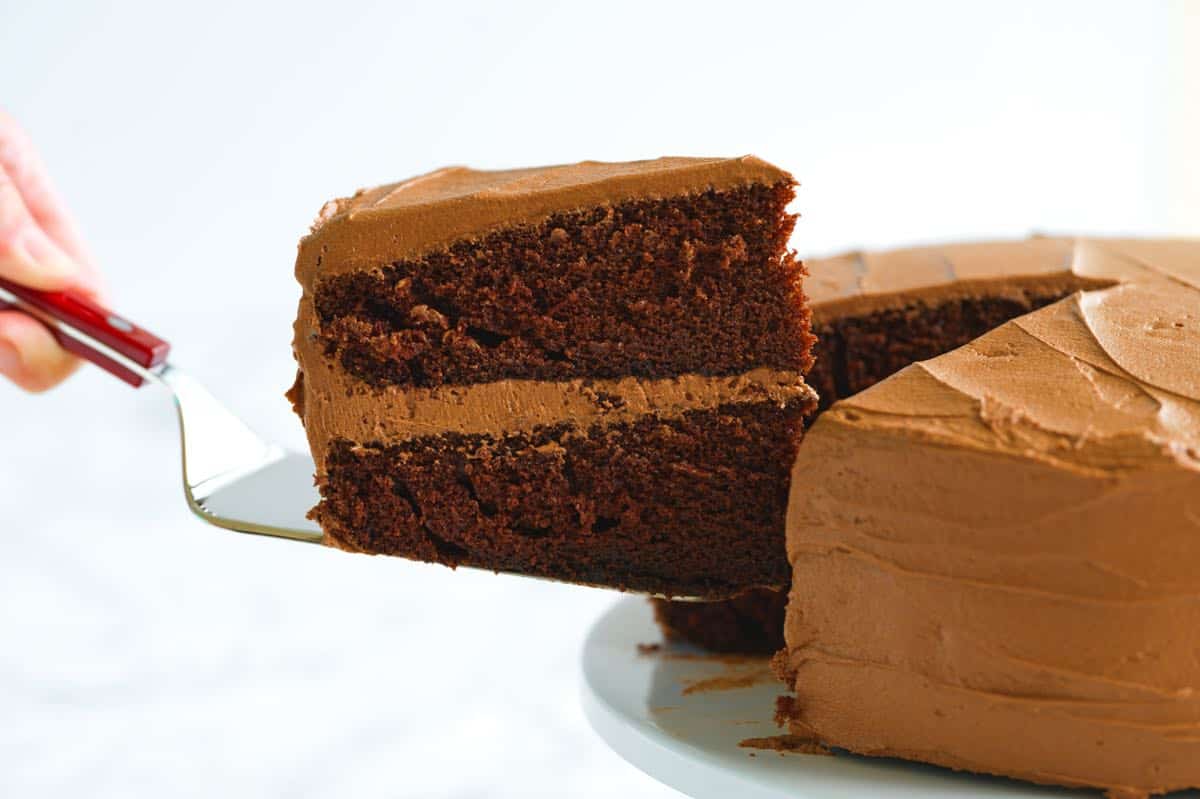
Easy Chocolate Cake
- PREP 20min
- COOK 26min
- TOTAL 46min
This is, hands-down, our family’s favorite homemade chocolate cake recipe, and it is perfect with our creamy chocolate buttercream frosting (also shared below). Adam loves chocolate cake, so naturally, this cake has become his birthday tradition.
Heating the cocoa powder with melted butter and coffee brings out the rich chocolate flavor of the cocoa and makes a big difference in the flavor of the cake after baking. You don’t really taste the coffee, but it helps make this cake taste like decadent chocolate. Buttermilk makes cake tender with a lovely, moist crumb. I highly recommend using real buttermilk, but I have included a tip for homemade buttermilk in the tips section below that uses milk and white vinegar.
You Will Need
- For Chocolate Cake
8 tablespoons unsalted butter (113g)
6 tablespoons vegetable oil (72g)
¾ cup natural cocoa powder, spooned and leveled, like Ghirardelli (63g)
1 teaspoon fine sea salt
2 teaspoons vanilla extract
¾ cup strong brewed hot coffee (170g)
2 cups all-purpose flour, spooned and leveled (260g)
1 ¾ cups granulated sugar (350g)
2 teaspoons baking soda
1 teaspoon baking powder
4 large eggs, at room temperature
1 cup buttermilk, well-shaken at room temperature (240ml)
- For Chocolate Buttercream
1 ¼ cups unsalted butter, at room temperature
¾ cups unsweetened cocoa powder (62g)
3 ½ cups powdered sugar (420g)
¼ teaspoon salt
½ teaspoon vanilla extract
4 tablespoons buttermilk, heavy cream, or milk
Directions
- Make Chocolate Cake
1Preheat oven and prepare cake pans: Preheat the oven to 350°F (180°C). Lightly grease two 9-inch cake pans, then line the bottom with a round of parchment paper (see tips for making one).
2Heat butter, oil, and cocoa: Melt the butter with the oil in a small saucepan over medium-low heat, add the cocoa powder, and stir to combine. Add the salt, vanilla, and coffee, and bring to a simmer. Once at a simmer, turn off the heat and let it sit for 2 minutes.
3Prepare dry ingredients: In a large bowl, whisk the flour, sugar, baking soda, and baking powder until very well combined.
4Make cake batter: Pour the cocoa mixture into the bowl with the dry ingredients and whisk until combined. Add the eggs one at a time, whisking well after each addition. Finally, whisk in the buttermilk until the batter is smooth.
5Bake cake layers: Divide the cake batter between the prepared cake pans. Bake in the preheated oven until the top springs back when very lightly touched in the center, and the edges begin to pull away from the edge of the pan. A toothpick or cake tester inserted in the center will come out clean, 26 to 30 minutes.
6Cool: Transfer the cake layers, still in the pans, to a wire rack to cool for 10 minutes. Then, turn them out onto the rack to cool completely before frosting (if the cake layers are even a little bit warm, the frosting will melt).
- Make Buttercream and Frost the Cake
1Prep dry ingredients: In a medium bowl, whisk or sift together the cocoa powder and powdered sugar. Set this aside.
2Beat the butter: Use a stand mixer with a paddle attachment or an electric hand mixer to beat the room-temperature butter on medium speed for 2 to 3 minutes. The butter should become noticeably lighter in color and creamy. Scrape down the sides and bottom of the bowl to make sure that it’s evenly mixed.
3Combine ingredients: With the mixer on low speed, add the powdered sugar and cocoa mixture to the butter, a heaped spoonful at a time, until thoroughly combined.
4Season and whip: With the mixer still running on low, add the salt, vanilla extract, and 2 tablespoons of buttermilk. Mix on medium-high speed for about 30 seconds, then check the consistency. The frosting should be thick and spreadable but not runny. If you want a softer, more whipped frosting, add the remaining 2 tablespoons of buttermilk, one tablespoon at a time, until you reach your desired consistency. For extra fluffy frosting, scraped down the sides and bottom of the bowl and beat again on medium-high to high speed for 10 to 15 seconds.
5Prepare cake layers: Once completely cool, if your cake layers have a dome, use a serrated knife to trim the bottom layer so it’s flat on top. You can do the same with the top layer, but I leave this domed. Leveling is an optional step, but it helps ensure a more level cake. I did not level the cakes in our photos.
6Assemble and frost the cake: Dab a small amount of frosting into the middle of your cake stand or serving plate to keep the cake in place. Place the first cake layer on top. Use roughly one-third of the frosting to spread an even layer over the top. Then, gently place the second cake layer on top. Use the remaining frosting to apply a generous and swoopy final layer over the top and sides of the cake.
Adam and Joanne's Tips
- Storing: Keep the frosted cake on the counter under a cake dome to keep it fresh for 3 to 4 days. Or store in the refrigerator up to 5 days. You can also freeze it (I like to freeze individual slices).
- Storing unfrosted cake layers: Unfrosted, baked cake layers can be wrapped and frozen for up to a month before frosting. Allow to thaw in the refrigerator.
- Make a parchment paper circle: Fold a sheet of parchment paper in half, then into a triangle. Hold the tip at the center of the pan and cut the paper along the pan’s edge. When you unfold it, you’ll have a circle that fits your pan.
- Different pan sizes: Bake for 32 to 35 minutes for a 9″x13″ pan and 23 to 26 minutes for two 8-inch round cake pans.
- Chocolate cupcakes: This recipe makes 2 to 3 dozen cupcakes. Fill the liners halfway, and bake in a 350°F (180°C) preheated oven for 18 to 20 minutes, or until the tops spring back when very lightly touched in the center. We also have this chocolate cupcake recipe.
- Dividing the batter: This recipe makes 1470g or 5 ½ cups of batter. For similarly sized cake layers, add 735g or 2 ¾ cups to each cake pan.
- Measuring the cocoa and flour: Weigh them or use the “spoon and level” method. Fluff the flour/cocoa, spoon it into the measuring cup, then level off the top with a flat edge.
- Homemade buttermilk: Stir 2 teaspoons white vinegar with 1 cup whole milk. Set aside for 5 to 10 minutes before using. You can substitute lemon juice for the vinegar.
- Prevent your cake from sinking in the middle: This can happen if the oven door is opened too early or if the cake is underbaked. Make sure your oven temperature is accurate and bake until a toothpick comes out clean. I set a timer for 25 minutes, and then check for doneness from there.
- Recipe inspired by Ina Garten, King Arthur Baking, and Hershey’s chocolate cake recipes.
- The nutritional information provided is an estimate.